

Scroll down for English
+
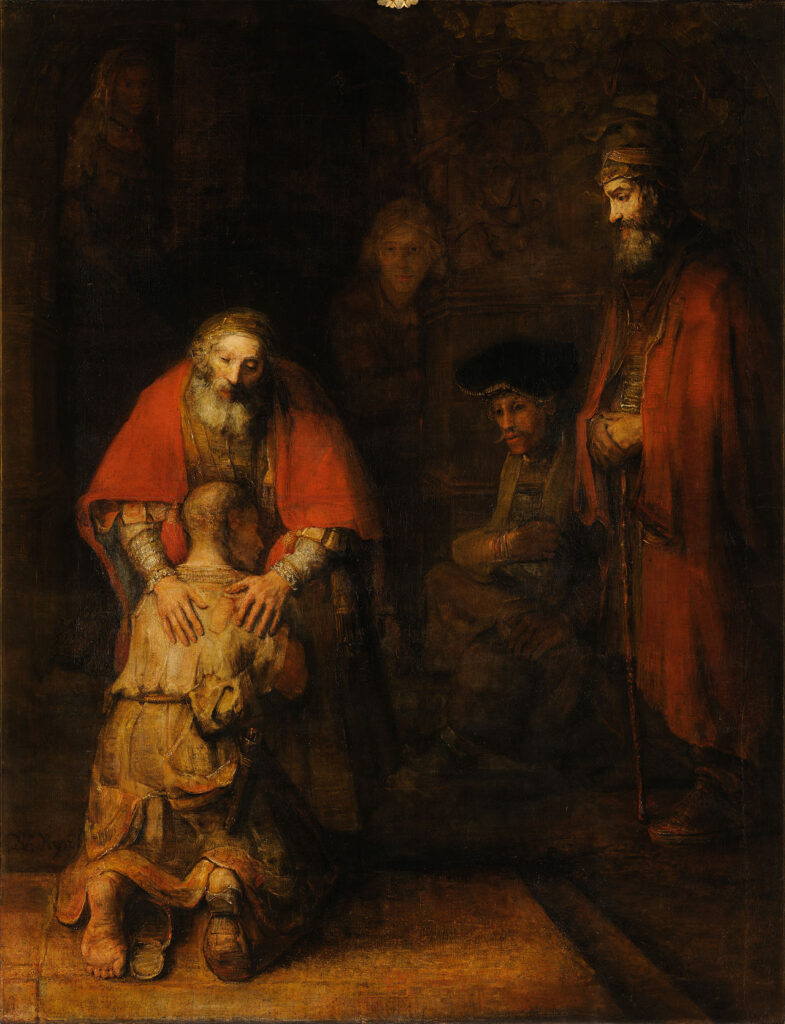
Ek wil na die gelykenis van die verlore seun kyk uit die perspektief van daardie sondes wat ons wanhopig laat.
Soms is daar enkele sondes wat ons so diep raak dat ons voel dat ons nie vergewe kan word nie, maar meesal is dit ons gewoontesondes – daardie sondes wat jy voel dat jou lyf of gedagtes amper onwillekeurig doen, omdat dit al so gewoond is om toe te gee aan die versoeking en te loop op die oorbekende paadjie van genot na verwyt, soos ‘n gevangene wat al in die rondte loop in sy sel.
Waarvan praat ons as ons praat van gewoontesondes? Natuurlik oor “the usual suspects”: wellustigheid, luiheid, vraatsigheid, woede, jaloesie.
Maar ook van hierdie, meer onsigbare sondes:
– die veroordeling van ander mense, wat ons so maklik, selfs onnadenkend doen;
– daarmee saam ons kritiese ingesteldheid teenoor groepe mense of individue, wat hulle inmessel in ons onveranderlike en afbrekende siening oor hulle;
– en die teenkant van die munt: die afkam van onsself; en die koestering van ons innerlike ouer broer, wat telkens oplet hoe sleg ons innerlike verlore seun is;
– van skeefgetrekte verhoudings en verhoudingspatrone, wat ons telkens op dieselfde destruktiewe manier laat reageer teenoor die mense om ons;
– van ons obsessiewe soeke na aardse gerief en sekuriteit, waarvoor ons haas enige prys sal betaal, selfs die skade aan ons siel;
– en van die argelose uitmors van die geestelike goed wat ons Vader vir ons gegee het.
In’t kort praat ek van al die sondes wat ons uiteindelik in ‘n ver land laat, honger, alleen, vuil, en huisloos. Met die grondige besef dat ons dit wat aan ons gegee is, verkwis het en dat ons geen aanspraak meer het op kindskap van die hemel nie.
En wat maak ons dan?
Die gelykenis van die verlore seun gee ons die antwoorde. Ons begin deur tot onsself te kom. Die Heilige Ambrosius sê hieroor: “Dis reg dat die Verlore Seun “tot homself kom.” Want hy wat terugkeer na God herstel homself aan homself, en hy wat vertrek van Christus, verwerp homself van homself.” Sonde vervreem ons van onsself. Elke tree op die paadjie van ons gewoontesonde is nie net ‘n tree weg van ons Vaderhuis nie, maar ook weg van wie ons ten diepste is – kinders van God.
Deel van tot onsself kom is ook ‘n besef van die erns van waarmee ons besig is. Want een van die redes hoekom gewoontesondes oor ons heers en dit regkry om ons oor ‘n lang tyd by vreeslike plekke laat uitkom, is juis die leuen wat ons onsself vertel dat hulle nie “so erg is nie”.
Die Heilige Paisios het gesê, “As iemand klein dingetjies nalaat is die gevaar dat hy groter, heiliger dinge sal begin nalaat. En dan, sonder dat hy dit besef, rasionaliseer hy dit alles vir homself, – “Dís niks, dáái maak nie saak nie” – en hy kan eindig – mag God dit verhoed – deur die dinge van God heeltemal na te laat en oneerbiedig, arrogant en ateïsties te word.”
Van hierdie leuen moet ons verlos word, en dikwels verg dit dat ons tussen varke eindig voordat ons tot onsself kom, en die reeks insigte het wat die verlore seun gehad het. Ek herhaal wat ek al ‘n paar keer in die verlede gesê het: ons moenie uit die oog verloor dat God in sy Voorsienigheid dikwels ons tussen die varke laat beland juis om tot onsself te kom nie. En daarvoor moet ons dankbaar wees.
Wanneer jy tot jouself gekom het, is die volgende stap ‘n voorneme: “Ek sal opstaan en na my vader gaan.” Let op dat die seun se voorneme nie akkuraat was nie. Hy misken sy kindskap – “ek is nie meer werd om u seun genoem te word nie” – en vergeet van sy vader se liefde vir hom.
Net so is ons voornemens ook dikwels gekleur deur waar ons is. Ons ag onsself óf slegter as wat ons is, óf ons onderskat die boosheid van wat ons gedoen het.
Maar sonder ‘n voorneme om na ons Vader terug te keer, sal ons nie uit die siklus van ons gewoontesondes ontsnap nie. Dis opmerklik dat die verlore seun ‘n baie definitiewe voorneme het, wat so ver strek as wat hy vir sy vader sal sê, en sy voorstel vir wat hy van sy vader verwag. Om van ons plek tussen die varke te ontsnap, moet ons ‘n voorneme hê wat ‘n beeld insluit van hoe die lewe sonder die varke en terug by ons Vaderhuis, sal lyk.
Nou moet ons ook onthou dat die verlore seun ver van sy vader se tuiste was. En hy begin met sy pad in ‘n toestand van honger. Sy voorneme sou deeglik getoets word.
‘n Lewe weg van ons gewoontesonde mag moeilik wees om te visualiseer, maar voor ons die pad aanpak, is dit nodig dat ons onsself versterk met ons voorneme.
En dan aksie. “En hy het opgestaan en na sy vader gegaan.”
Hoe doen ons dit? Ek kan dit nie beter sê as die Heilige Porphyrios nie:
“Sonder Christus is dit onmoontlik om onsself reg te stel. Ons sal onsself nie van ons passies kan losmaak nie. Op ons eie kan ons nie goed word nie. “Sonder My kan julle niks doen nie,” sê Christus. Hoe hard ons ook al probeer, ons sal niks bereik nie. Daar is een ding wat ons moet doen, en dit is om ons tot Hom te wend en Hom met ons hele siel lief te hê. Liefde vir Christus; dit is die beste en enigste geneesmiddel vir die passies.
God het ‘n krag in die mens se siel geplaas. Maar dit hang van hom af hoe hy dit kanaliseer – ten goede of ten kwade. As ons die goeie as ‘n tuin vol blomme, bome en plante voorstel; en die bose as onkruid en dorings; en die krag as water, dan kan die volgende gebeur: wanneer die water na die blomtuin gelei word, dan groei al die plante, blom en dra vrugte; en terselfdertyd verdor en sterf die onkruid en dorings, omdat hulle nie natgemaak word nie. En die teenoorgestelde kan natuurlik ook gebeur.
Dit is daarom nie nodig om julle oor die onkruid te bekommer nie. Moenie julleself besig hou met die uitroei van die bose nie. Christus wil nie hê dat ons onsself met die hartstogte moet besig hou nie, maar met die teenoorgestelde daarvan. Kanaliseer die water, dit wil sê, al die krag van jou siel, na die blomme, dan sal jy hul skoonheid, hul geur en hul varsheid geniet.
Julle sal nie heiliges word deur die bose te agtervolg nie. Ignoreer die bose. Kyk na Christus en Hy sal jou red. In plaas daarvan om buite die deur te staan en die bose weg te jaag, behandel hom met minagting. As die bose van een rigting nader, draai dan kalm in die teenoorgestelde rigting. As die bose jou aanval, draai al jou innerlike krag na die goeie, na Christus. Bid: “Here Jesus Christus, wees my genadig.” Hy weet hoe en op watter manier om jou genadig te wees. En wanneer jy jouself met die goeie gevul het, moenie meer na die bose toe draai nie. Op hierdie manier word jy op jou eie goed, met die genade van God. Waar kan die bose dan ‘n vastrapplek kry? Dit verdwyn!
Alle dinge is moontlik met Christus. Waar is die pyn en moeite vir jou om goed te word? Dinge is eenvoudig. Jy sal God aanroep en Hy sal dinge in die goeie verander. As jy jou hart aan Hom gee, sal daar geen ruimte wees vir ander dinge nie. Wanneer jy “Christus aantrek”, sal jy geen moeite nodig hê om deug te verkry nie. Hy sal dit vir jou gee. Word jy oorweldig deur vrees en ontnugtering? Wend jou tot Christus. Wees eenvoudig en nederig lief vir Hom, sonder enige eis, en Hy self sal jou bevry. Wend jou tot Christus en sê met nederigheid en hoop, soos die Heilige Paulus: “Wie sal my verlos van die liggaam van hierdie dood?” Wend jou dus tot Christus, en Hy sal onmiddellik kom. Sy genade sal onmiddellik handel.”
Dis hoe ons moet loop. En eendag, as ons nog ver is van die huis, sal ons Vader, wat gedurig op die uitkyk is vir ons, ons sien en innig jammer vir ons voel en hardloop en ons omhels en ons hartlik soen. Amen.

+
This morning I want to look at the parable of the prodigal son from the perspective of those sins that drive us to despair.
Sometimes we do sins that affect us so deeply that we feel we cannot be forgiven, but mostly our despair is caused by habitual sins—those sins that you feel your body or thoughts perform almost involuntarily, because they have become so accustomed to giving in to temptation; to walking once again along the all-too-familiar path from pleasure to remorse, like a prisoner who endlessly paces around his cell.
What do we mean when we speak of habitual sins? Of course, the “usual suspects”: lust, sloth, gluttony, anger, envy.
But also these, more hidden sins:
– judging other people, which comes to us so easily, often without thinking;
– together with that, our critical attitude toward groups of people or individuals, which walls them up in our fixed and destructive view of them;
– and the flip side of the coin: tearing ourselves down, and nurturing our inner elder brother, who constantly keeps watch over how bad our inner prodigal son is;
– distorted relationships and relational patterns, which repeatedly cause us to react in the same destructive way toward the people around us;
– our obsessive pursuit of earthly comfort and security, for which we are willing to pay almost any price, even damage to our soul;
– and the careless wasting of the spiritual goods our Father has given us.
In short, I am speaking of all the sins that ultimately leave us in a far-off land—hungry, alone, filthy, and homeless—with the deep realization that we have squandered what was given to us and that we no longer have any claim to sonship of heaven.
And what do we do then?
The parable of the prodigal son gives us the answers. We begin by coming to ourselves. Saint Ambrose says of this: “It is right that the Prodigal Son ‘comes to himself.’ For he who returns to God restores himself to himself, and he who departs from Christ rejects himself from himself.” Sin alienates us from ourselves. Every step along the path of our habitual sin is not only a step away from our Father’s house, but also away from who we are at our core – children of God.
Part of coming to ourselves is also an awareness of the seriousness of what we are doing. For one of the reasons why habitual sins rule over us and succeed in leading us, over a long period of time, to dreadful places, is precisely the lie we tell ourselves that they are “not that bad.”
Saint Paisios said, “If someone neglects small things, there is the danger that he will begin to neglect greater, holier things. And then, without realizing it, he rationalises everything to himself—‘This is nothing, that doesn’t matter’—and he may end up—God forbid—neglecting the things of God entirely and becoming irreverent, arrogant, and atheistic.”
We must be freed from this lie, and often it requires that we end up among the pigs before we come to ourselves and have the series of insights that the prodigal son had. I repeat what I have said several times in the past: we must not lose sight of the fact that God, in His Providence, often allows us to end up among the pigs precisely so that we may come to ourselves. And for that we should be grateful.
When you have come to yourself, the next step is a resolution: “I will arise and go to my father.” Notice that the son’s resolution was not accurate. He denies his sonship—“I am no longer worthy to be called your son”—and forgets his father’s love for him.
In the same way, our resolutions are often colored by where we find ourselves. We either regard ourselves as worse than we are, or we underestimate the evil of what we have done.
But without a resolution to return to our Father, we will not escape the cycle of our habitual sins. It is striking that the prodigal son has a very definite resolution, extending even to what he will say to his father and his proposal for what he expects from him. To escape our place among the pigs, we must have a resolution that includes an image of what life without the pigs and back in our Father’s house will look like.
We must also remember that the prodigal son was far from his father’s home, and that he set out on his journey in a state of hunger. His resolve would be thoroughly tested.
A life away from our habitual sin may be difficult to imagine, but before we set out on the road, it is necessary that we strengthen ourselves with our resolutions.
And then action: “And he arose and went to his father.”
How do we do this? I cannot say it better than Saint Porphyrios:
“Without Christ it is impossible to correct ourselves. We will not be able to detach ourselves from our passions. On our own we cannot become good. “Without me, you can do nothing.” However much we try, we will achieve nothing. There is one thing we must do, and that is to turn to Him and love Him with all our soul. Love for Christ; this is the best and sole remedy for the passions.
God has placed a power in man’s soul. But it is up to him how he channels it – for good or for evil. If we imagine the good as a garden full of flowers, trees and plants and the evil as weeds and thorns and the power as water, then what can happen is as follows: when the water is directed towards the flower-garden, then all the plants grow, blossom and bear fruit; and at the same time the weeds and thorns, because they are not being watered, wither and die. And the opposite, of course can also happen.
It is not necessary, therefore, to concern yourselves with the weeds. Don’t occupy yourself with rooting out evil. Christ does not wish us to copy ourselves with the passions, but with the opposite. Channel the water, that is, all the strength of your soul, to the flowers, and you will enjoy their beauty, their fragrance and their freshness.
You won’t become saints by hounding after evil. Ignore evil. Look towards Christ and He will save you. Instead of standing outside the door shooing the evil one away, treat him with disdain. If evil approaches from one direction, then calmy turn in the opposite direction. If evil comes to assault you, turn all your inner strength to good, to Christ. Pray, “Lord Jesus Christ, have mercy on me.” He knows how and in what way to have mercy on you. And when you have filled yourself with good, don’t turn any more towards evil. In this way you become good on your own, with the grace of God. Where can evil then find a foothold? It disappears!
All things are possible with Christ. Where are the pain and effort for you to become good? Things are simple. You will invoke God and He will transform things into good. If you give your heart to Him, there will be no room for other things. When you “put on Christ”, you will not need any effort to attain virtue. He will give it to you. Are you engulfed by fear and disenchantment? Turn to Christ. Love Him simply and humbly, without any demand, and He Himself will free you. Turn to Christ and say with humility and hope like Saint Paul, Who shall deliver me from the body of this death? Turn towards Christ, therefore and He will come immediately. His grace will act at once.”
This is how we should walk. And one day, while we are still far from home, our Father, constantly looking out for us, will see us and be deeply moved with compassion, and He will run to us and embrace us and kiss us warmly. Amen.