

Scroll down for english
+
Vandag is die feesdag van die Heilige Macarius die Grote, ‘n verstommende man van wie ek julle ná die Liturgie iets sal vertel. Vir die oomblik wil ek begin met ‘n beroemde aanhaling van hom:
“Die hart is maar ‘n klein houer, maar daar is ook drake en daar is leeus; daar is giftige ondiere en al die skatte van boosheid . . . daar is ook God, ook die engele, die lewe en die koninkryk, die lig en die Apostels, die skatte van genade – daar is alle dinge.”
Ek het laas week gesê dat ons op pad is na die Groot Vastyd en in hierdie weke nadink oor bekering. En ons dink na oor bekering omdat, soos Metropoliet Kallistos Ware dit gestel het, bekering die deur is na die Groot Vastyd. Met bekering bedoel ons wat die Grieke “metanoia” noem, wat beteken om om te draai of jou gedagtes te verander.
Laas week het ons die ware verhaal gehoor van die tollenaar Saggeüs, wat hom bekeer het en gered is omdat Christus by hom tuisgegaan het en hom die skoonheid in homself gewys het. Dit het hom in staat gestel om homself te verneder en te beskaam deur te onderneem om die opbrengs van sy oortredings vierdubbeld terug te betaal.
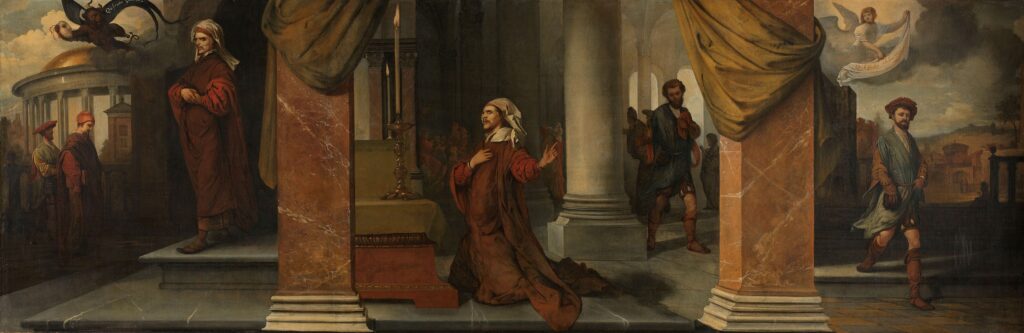
In die gelykenis wat Christus in vandag se Skriflesing vertel, gaan twee mense op na die tempel om te aanbid. En hulle gebede begin op dieselfde manier: “O God . . .”
Maar hier hou die ooreenkoms tussen hulle op. Want die Fariseër se gebed, hoewel dit op die oog af ‘n dankgebed is, is in werklikheid ‘n selfverheerliking. En teenoor wie verheerlik hy homself? Voor God, teenoor ander mense, en spesifiek “dié tollenaar”.
Hy verheerlik homself omdat hy die belangrikste twee asketiese dissiplines van die Groot Vastyd – vas en die gee van aalmoese – nagekom het. Hier is ‘n ooglopende beginsel om oor na te dink. Askese kan ook verkeerd gedoen word, in vertroue op onsself, soos die Evangelieskrywer in die aanloop tot die verhaal sê, en dien om onsself teenoor ander te verheerlik eerder as om onsself te bekeer. Dis daarom ons gesindheid teenoor askese, net soveel as die askese self, wat die uitkoms daarvan bepaal.
Kyk ons verder, sien ons iets waaroor ek ook onlangs gepraat het. Die Fariseër se siening van sy geloofslewe is juridies. Daar is ‘n stel reëls – jy moet vas en tiendes gee – en as jy dit nagekom het, dan kan jy dit gebruik om jou teenoor jou naaste en God te regverdig. Dis ‘n perspektief wat na buite kyk en wat met jou hart niks te make het nie. Dit vermy die werklikheid van die drake en die leeus en die giftige ondiere in ons hart. En dit vermy ook die skaamte oor ons sonde.
Maar die Kerkvaders leer dat die sonde ons siek gemaak het. Dit beteken dat ons heling nodig het, nie straf nie. As ons na sonde kyk in terme van die nakom of oortreding van eksterne reëls, en van Christus se kruisdood as boetedoening vir ons sondes namens ons, sal ons nooit die besef ontwikkel dat ons siek is en heling nodig het nie. Wat natuurlik beteken dat ons nooit geestelik gesond word nie. Soos een van die woestynvaders gesê het: Dit is beter dat ‘n man gesondig het, as hy weet dat hy gesondig het en hom bekeer, as ‘n man wat nie gesondig het nie maar dink dat hy regverdig is.
Die verdere probleem met die perspektief na buite, wat weier om na die drake en ongediertes in ons harte te kyk, is dat dit ook die engele, die lewe en die koninkryk, die lig en die Apostels, en die skatte van genade miskyk – anders gestel, die Skoonheid waarvan ons laas week gepraat het. Ons sou ook kon sê dat die Fariseër moreel skoon was maar blind was vir Skoonheid.
Wat ons bring by die tollenaar. Dis opmerklik dat die gelykenis swyg oor waar die tollenaar se verpletterende sondebesef vandaan kom. Maar wat ons wel sien, is die volgende. Sy aanspreek van God, voel ons instintief aan, kom diep uit sy hart, anders as die Fariseër sin, wat blote vorm is. En daar is by die tollenaar geen poging tot selfregverdiging nie.
Nee, sy gebed is ‘n noodkreet, ‘n kreet van pyn, ‘n kreet om hulp. Dis gebore uit die skaamte wat die gevolg is daarvan dat hy sy sonde vierkant in die oë kyk.
En omdat hy die drake, leeus en ongediertes sien vir wat hulle is, besef hy ineens ook dat hy homself nie van sy siekte kan genees nie, dat hy teen ‘n oormag te staan gekom het. Maar saam met hierdie besef is daar ook die besef dat hy hulp by God kan kry, vandaar sy kreet om hulp.
Hoe kom ons by ons innerlike tollenaar uit? Soms, deur God se genade, gebeur daar ‘n katastrofe wat ons tot by hierdie punt bring. En miskien moet ons weer na die katastrofes in ons lewe gaan kyk en besef dat dit deels hulle doel is.
Maar as ons nie daartoe gedwing word nie maar dit ons behoefte is, is die eerste stap om ons innerlike Fariseër te sien vir wie hy is en te verstaan hoe sy perspektief werk. En dit dan af te wys. Ek hoor dikwels in die bieg hoe mense moeite doen om die omstandighede van hulle sondes te verduidelik. Mens moet besef wat hier aan die gang is: ons probeer verduidelik hoekom ons nie heeltemal so skuldig is nie, want iemand of iets anders het ‘n rol gespeel in die veroorsaking van ons sondes en behoort daarom deel van die skuld te dra. Dis ons innerlike Fariseër wat so praat. Die bieg is nie ‘n hofsaal nie – dis ‘n operasiekamer.
Die volgende ding wat ons kan doen is om eerlik en met gebed na ons hart te kyk. Dit is die eintlike doel van askese, omdat dit ons geestelik meer sensitief maak. Die irritasie wat ons voel wanneer die hongerpyne begin knaag of wanneer ons alweer verontrief word deur ‘n naaste met ‘n behoefte, is telkens die skuif van die skaduwee van ‘n ongedierte in ons hart.
Dan: neem die tyd en doen die moeite om ‘n deeglike opname van jou sondes te doen. Die aanloop tot die Groot Vastyd is ‘n goeie tyd daarvoor. Hoe werk dit? Jy sit die tyd opsy, kry ‘n gids – daar is verskeie goeie gidse hiervoor op die internet, of jy kan my daarvoor vra – en ondersoek dan jouself, jou dade en gedagtes die afgelope tyd, om te kyk waar jy die teiken van die liefde gemis het. Dis goed om dit te doen terwyl jy vas, so ‘n Sondagoggend vroeg is ‘n goeie tyd daarvoor. En jy kan jou selfondersoek begin met ‘n opname van soveel van God se gawes aan jou as waaraan jy kan dink.
Wanneer jy dit gedoen het, bring jy jou sondes Kerk toe – en as jy nog nie in die Kerk opgeneem is nie, bring jy jou sondes na God toe – en bely hulle so eenvoudig as wat jy kan, met die begeerte en voorneme en gebed om verander te word, om om te draai, en met die besef dat dit net God is wat dit kan doen.
Deur ons onsself só te beskaam en verneder, en wanneer ons saam met die tollenaar bid, “O God, wees my, ‘n sondaar, genadig!”, gaan ons op reis van ons kop na ons hart. En gaandeweg ontwikkel ons die armoede van gees wat ons die koninkryk van die hemele in ons harte sal laat sien, die lig van skoonheid, en die skatte van God se genade. Amen.

+
Today is the feast day of Saint Macarius the Great, an amazing man about whom I will tell you something after the Liturgy. For the moment, I want to start with a famous quote from him:
“The heart is but a small vessel, but there are also dragons and there are lions; there are poisonous beasts and all the treasures of evil . . . there is also God, also the angels, life and the kingdom, the light and the Apostles, the treasures of grace – there are all things.”
I said last week that we are making our way towards Great Lent and in these weeks we are thinking about repentance. And we are thinking about repentance because, as Metropolitan Kallistos Ware put it, repentance is the door to Great Lent. By repentance we mean what the Greeks call “metanoia,” which means to turn around or change your mind.
Last week we looked at the tax collector Zacchaeus, who was converted and saved because Christ came to his home and showed him the beauty within himself. This enabled him to humble and shame himself by undertaking to repay the proceeds of his transgressions fourfold.
In the parable that Christ tells in today’s Scripture reading, two people go up to the temple to worship. And their prayers begin in the same way: “O God…”
But here the similarity between them ends. For the Pharisee’s prayer, although on the surface a prayer of thanksgiving, is in reality a self-glorification. And to whom does he glorify himself? Before God, towards other people, and specifically “this tax collector.”
He glorifies himself because he has observed the two most important ascetic disciplines of Great Lent—fasting and almsgiving. Here is an obvious principle to ponder. Asceticism can also be done in the wrong way, trusting in ourselves, as the Gospel writer says in the lead-up to the story, and serving to glorify ourselves to others rather than to be converted. Therefore it is our attitude towards asceticism, as much as the asceticism itself, that determines its result.
Looking further, we see something that I also spoke about recently. The Pharisee’s view of his religious life is juridical. There is a set of rules – you must fast and tithe – and if you have observed them, then you can use them to justify yourself to your neighbour and to God. It is a perspective that looks outward and has nothing to do with your heart. It avoids the reality of the dragons and the lions and the poisonous beasts in our hearts. And it also avoids the shame of our sin.
But the view of the Church Fathers is that sin has made us sick. This means that we need healing, not punishment. If we look at sin in terms of keeping or breaking external rules, and of Christ’s death on the cross as atonement for our sins on our behalf, we will never develop the realisation that we are sick and in need of healing. Which of course means that we will never become spiritually healthy. As one of the desert fathers said: “It is better for a man to have sinned, if he knows that he has sinned and repents, than for a man who has not sinned but thinks that he is righteous.”
The further problem with the outward perspective, which refuses to look at the dragons and beasts in our hearts, is that it also overlooks the angels, the life and the kingdom, the light and the Apostles, and the treasures of grace – in other words, the Beauty we spoke of last week. We could also say that the Pharisee was morally clean but was blind to Beauty.
Which brings us to the tax collector. It is noteworthy that the parable is silent about where the tax collector’s crushing awareness of sin comes from. But what we do see is the following. His appeal to God, we instinctively feel, comes from deep within his heart, unlike the Pharisee’s appeal, which is mere form. And there is no attempt at self-justification on the part of the tax collector.
No, his prayer is a cry of distress, a cry of pain, a cry for help. It is born of the shame that results from looking his sin squarely in the eye.
And because he sees the dragons, lions and beasts for what they are, he at once realizes that he cannot cure himself of his illness, that he has come up against an overwhelming force. But along with this realization there is also the realization that he can get help from God, hence his cry for help.
How do we get to our inner tax collector? Sometimes, by God’s grace, a catastrophe happens that brings us to this point. And perhaps we need to look again at the catastrophes in our lives and realize that this is part of their purpose.
But if we are not forced to do so but have a need to, the first step is to see our inner Pharisee for who he is and to understand how his perspective works. And then reject it. I often hear in confession how people take care to explain the circumstances of their sins. One has to realize what is going on here: we are trying to explain why we are not quite so guilty, because someone or something else played a role in causing our sins and should therefore bear some of the blame. That is our inner Pharisee talking. Confession is not a courtroom – it is an operating room.
The next thing we can do is to look honestly and prayerfully at our heart. This is the real purpose of asceticism, because it makes us more spiritually sensitive. The irritation we feel with others when hunger pangs begin to gnaw or when we are once again inconvenienced by a neighbor in need, is invariably the movement of the shadow of a beast in our heart.
Then: take the time and make the effort to do a thorough survey of your sins. The run-up to Great Lent is a good time for this. How does it work? You set aside the time, get a guide – there are several good guides for this on the internet, or you can ask me for one – and then examine yourself, your recent actions and thoughts, to see where you have missed the mark of love. It is good to do this while you are fasting, so early on a Sunday morning is a good time for it. And you can begin your self-examination with a survey of as many of God’s gifts to you as you can think of.
When you have done this, you bring your sins to the Church – and if you are not yet received into the Church, you bring your sins to God – and confess them as simply as you can, with the desire and intention and prayer to be changed, to turn around, and with the realization that it is only God who can do this.
By thus shaming and humiliating ourselves, and when we pray with the tax collector, “O God, be merciful to me, a sinner!”, we go on a journey from our head to our heart. And gradually we develop the poverty of spirit that will make us see the kingdom of heaven in our hearts, the light of beauty, and the treasures of God’s grace. Amen.