

Sroll down for english
+
Vandag se verhaal gaan oor ‘n krimineel. ‘n Kort, knap krimineel. En die kort knap krimineel is nuuskierig. Hy hoor daar kom ‘n beroemde prediker naby sy huis verby en hy wil gaan kyk. Soos mense gaan kyk as daar ‘n bekende sportster of ‘n rymkletser in die omtes is. Maar daar is te baie mense met dieselfde idee as hy en die skare verhoed dat hy die prediker te siene kry.
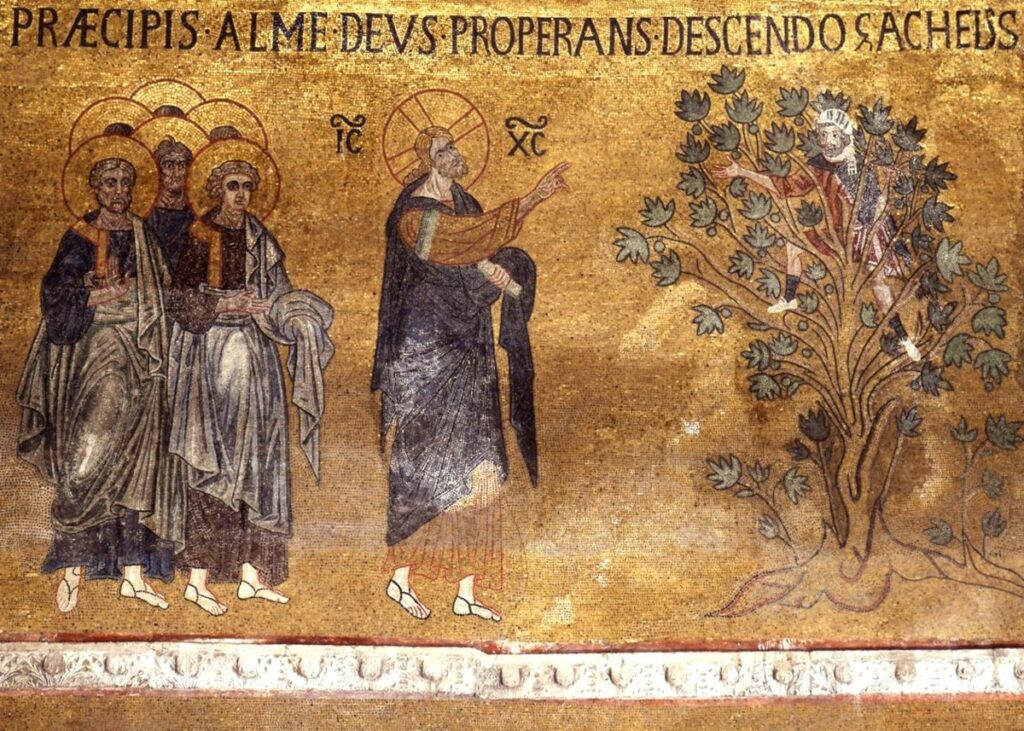
Maar die kort knap krimineel is ondernemend. Hy sien waarheen die skare gaan loop en sien ook ‘n groot wildevyeboom langs die pad. So hy hardloop op sy kort beentjies vooruit en gaan klim in die boom. Om beter te kan sien.
Wat het Saggeüs uitgegaan om te sien? Wat wou hy uit dié spektakel kry? Wat het hom en die skare beweeg om rondom Jesus saam te koek waar Hy ook al gegaan het?
Mens kan lank hieroor praat. Maar ek wil met julle ‘n insig deel wat ek gekry het by ‘n Belarussiese non wat werk met alkoholiste op ‘n plaas in die klooster waar sy bly. Sy sê dat sy baie erg is oor skoonheid. En soos sy praat hoor mens tussen die lyne dat sy aanvanklik half teleurgesteld was omdat sy die obediënsie, of gehoorsaamheid, gekry het om met dié lelikerds te werk. Maar sy sê dat sy geleer het om aandag aan mense se binnewêrelde te gee en in mense se oë te kyk, eerder as na hulle uiterlike onvolmaaktheid.
Dít is wat mense by Jesus begeer het – sy vermoë om in mense se oë te kyk, verby die lelikheid, na die skoonheid in hulle harte, wat hunker na die Bron van daardie skoonheid.
Ons leef in ‘n tyd van waansinnige begeerte. ‘n Groot deel van ons begeerte is na skoonheid van verskillende soorte. Baie produkte word verkoop op die rug van die skoonheid van ‘n model se voorkoms, of van die prag van die “ontwerp” van ‘n nuwe geriefie, of van hoe akkuraat en getrou ‘n skerm ‘n beeld kan weergee – en het jy opgelet dat dié beeld nege uit die 10 keer asemrowende natuurtonele is?
Die Franse filosoof René Girard het gesê dat “alle begeerte is ‘n begeerte na syn”. Girard se oorkoepelende teorie is nie maklik nie en ek gaan julle nie daarmee belas nie – ek wil net een liggie daaruit gebruik. Hy sê dat ons begeerte uiteindelik nie na dinge is nie, maar om soos, of eenvoudiger, die een te wees wat die ding besit wat ons begeer.
Ons begeerte na dinge en mense is daarom eintlik ‘n begeerte om iemand te wees. Die probleem is dat ons mooi wil wees deur dinge te begeer. Ons begeer om mooi te wees deur mooi te besit. Ons begeer om hemelse wesens te wees deur aardse, stoflike dinge te verkry.
Die probleem daarmee is dat ‘n begeerte wat sy verband verloor het met die Bron van die skoonheid, lelik word. Dit is hoekom ons wêreld ten spyte van ons desperate begeerte na skoonheid, sedert die wanbenaamde Verligting so lelik geword het: omdat ons die verbindtenis met die Oorsprong van die Skoonheid verloor het en ons begeerte beperk het tot die besit van die stoflike.
Dit was ook Saggeüs se probleem. Hy was ‘n hoof van die tollenaars en ‘n ryk man. Maar sy begeerte na goed het hom blind gemaak vir ware skoonheid. Hy het mense afgepers om nóg meer geld te maak. Sy soeke na skoonheid het hom lelik teenoor mense gemaak en hy het daarom self lelik geword. En tog: hy het iets begeer wat meer was as dit wat hom lelik gemaak het. Dís hoekom hy die boom gaan klim het.
Toe kom staan Jesus onder die boom en kyk op en sien hom. Hy kyk verby die lelike krimineel, deur sy oë tot in sy hart. En sê:
“Saggéüs, maak gou en klim af, want Ek moet vandag in jou huis bly.”
En Jesus het tuis gegaan by die kort, lelike krimineel. En vir Saggeüs gewys dat hy iets het om te bied, dat hy gasvry kan wees, dat hy ‘n tuiste kan bied vir dié liefdevolle Man, dat daar tóg iewers skoonheid is in hom.
Dit is wat sy lewe omvorm het, wat redding vir hom en sy huis gebring het. Maar eers: toe die mense sien dat Jesus by Saggeüs tuisgaan, het hulle gemurmureer, want Saggeüs was ‘n lelike, sondige man. Saggeüs het nie gereageer deur te probeer om die lelikheid weg te steek nie. Nee, hy het dit selfs beklemtoon: “Here, kyk, ek gee die helfte van my goed vir die armes, en as ek van iemand iets afgepers het, gee ek dit vierdubbel terug.” Waar daar vantevore grypende gierigheid was, was daar nou vrygewige liefdesbetoning.
Hoe het dit so skielik gebeur? Hoe is Saggeüs en sy huis so skielik gered? Omdat Saggeüs die Bron van die Skoonheid by hom aan huis gehad het. Hy het die hemelse Skoonheid ervaar en die vlam van begeerte daarvoor is in sy hart aangesteek. En hy het ineens besef dat die vlam van die hemelse Skoonheid in ons lewens aan die brand gehou word met aardse goed, wat op sy beurt aan andere húlle skoonheid wys. Want wat is mooier en meer bevestigend van ons lelike naaste se goddelike skoonheid as om hulle behoeftes in liefde te vervul, soos wat Christus met Saggeüs gedoen het?
Dít is wat die non gesien het. Dít is wat ons moet sien.
Hierdie Sondag begin ons met die aanloop tot die Groot Vastyd. Dis ‘n tyd waarin ons opnuut dink oor bekering. Ons dink dikwels aan bekering as ‘n selfveroordeling wat eintlik selfkastyding is. Maar ons moet besef dat Saggeüs tot bekering gekom het omdat Christus hom kom wys het dat daar ‘n goddelike skoonheid in hom was.
Laat ons daarom, soos wat ons begin dink oor bekering, eers vir God vra om ook by óns tuis te gaan en ons te wys dat ons ‘n goddelike skoonheid in ons het, sodat ons soos Saggeüs ons kan bekeer met ‘n ligte, dankbare hart.
Aan die Bron van Skoonheid, wat ons mooi en goed gemaak het omdat Hy vir ons lief is, en toe ons verlore geraak het gekom het om te soek en te red wat verlore was, kom toe die lof en die eer en die aanbidding, nou en altyd en tot in ewigheid. Amen.

+
Today’s story is about a criminal. A squat, clever criminal. The squat clever criminal is curious. He hears that a famous preacher is passing near his house and he wants to go and see. The way people go to look when a well-known sports star or a rapper is in the area. But there are too many people with the same idea as he has, and the crowd prevents him from seeing the preacher.
But the squat clever criminal is enterprising. He sees where the crowd is heading and also notices a large wild fig tree next to the road. So he runs ahead on his short little legs and climbs into the tree. All the better to see.
What did Zacchaeus go out to see? What did he want to get out of this spectacle? What moved him, and the crowd, to flock around Jesus wherever He went?
One could speak at length about this. But I want to share with you an insight I gained from a Belarusian nun who works with alcoholics on a farm at the monastery where she lives. She says that she is very passionate about beauty. And as she speaks one can hear between the lines that she was initially somewhat disappointed because she was given the obedience to work with these ugly people. But she says that she learned to pay attention to people’s inner worlds and to look into people’s eyes, rather than at their outward imperfections.
This is what people desired in Jesus — His ability to look into people’s eyes, past the ugliness, to the beauty in their hearts, which longs for the Source of that beauty.
We live in a time of mad desire. A large part of our desire is for beauty of various kinds. Many products are sold on the strength of the beauty of a model’s appearance, or the splendor of the “design” of a new gadget, or of how accurately and faithfully a screen can reproduce an image—and have you noticed that nine times out of ten that image is breathtaking scenes of nature?
The French philosopher René Girard said that “all desire is a desire for being.” Girard’s overarching theory is not easy, and I am not going to burden you with it—I only want to use one little light from it. He says that our desire is ultimately not for things, but to be like, or to be, the one who possesses the thing that we desire.
Our desire for things and for people is therefore actually a desire to become someone. The problem is that we want to become beautiful by desiring things. We desire to be beautiful by possessing beauty. We desire to be divine beings by acquiring earthly, material things.
The problem with this is that a desire which has lost its connection with the Source of beauty becomes ugly. That is why our world, despite our desparate desire for beauty, has become so ugly since the misnamed Enlightenment: because we have lost the connection with the Origin of Beauty and have limited our desire to the possession of the material.
This was also Zacchaeus’s problem. He was a chief tax collector and a rich man. But his desire for possessions had made him blind to true beauty. He extorted people in order to make even more money. His search for beauty made him ugly toward people, and for this reason he himself became ugly. And yet: he desired something that was more than what had made him ugly. That is why he went to climb the tree.
Then Jesus came and stood under the tree and looked up and saw him. He looked past the ugly criminal, through his eyes into his heart. And He said:
“Zacchaeus, hurry and come down, for today I must abide at your house.”
And Jesus went home with the short, ugly criminal. And He showed Zacchaeus that he had something to offer, that he could be hospitable, that he could offer a home to this loving Man, that there was, after all, some divine beauty somewhere in him.
This is what transformed his life, what brought salvation to him and his household. But first: when the people saw that Jesus was going to Zacchaeus’s house, they murmured, because Zacchaeus was an ugly, sinful man. Zacchaeus did not respond by trying to hide the ugliness. No, he even emphasized it: “Lord, look, I give half of my goods to the poor, and if I have extorted anything from anyone, I give it back fourfold.” Where there had previously been grasping greed, there was now generous love in action.
How did this happen so suddenly? How were Zacchaeus and his house so suddenly saved? Because Zacchaeus had the Source of Beauty as a guest in his home. He experienced divine Beauty, and the flame of desire for it was kindled in his heart. And he suddenly realized that the flame of divine Beauty in our lives is kept burning with earthly goods, which in turn show others their own beauty. For what is more beautiful and more affirming of our ugly neighbor’s divine beauty than to fulfill our their needs in love, as Christ did with Zacchaeus?
This is what the nun saw. This is what we must see.
This Sunday we begin the approach to Great Lent. It is a time in which we once again think about repentance. We often think of repentance as a self-condemnation that is really a form of self-punishment. But we must realize that Zacchaeus came to repentance because Christ came and showed him that there was a divine beauty in him.
Let us therefore, as we begin to think about repentance, first ask God also to come and abide in our home and to show us that we have a divine beauty within us, so that, like Zacchaeus, we may repent with a light, grateful heart.
To the Source of Beauty, Who made us beautiful and good because He loves us, and Who, when we were lost, came to seek and to save what was lost, be the praise and the honor and the worship, now and always and unto ages of ages. Amen.